
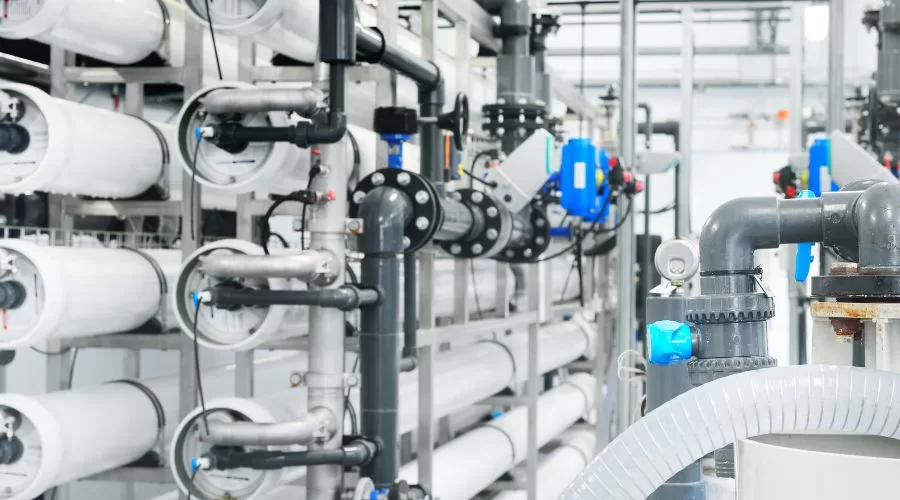
Every day, business owners and chief technologists look for ways to improve operational efficiency, enhance production quality, and better meet customer requirements. These challenges are especially critical in the food industry, which operates under intense market competition and is gradually transitioning to European production standards. In this context, the use of water that complies with both national and international regulations and standards is a key factor.
An industrial reverse osmosis system is a modern and highly efficient method of water treatment used not only for drinking purposes but also to meet strict industrial standards. Such systems are capable of removing up to 99% of contaminants, including mechanical impurities, organic matter, chlorine and chlorinated compounds, heavy metals, iron and manganese, as well as viruses and bacteria. This ensures not only safety but also provides the finished product with excellent sensory characteristics.
Industrial enterprises across various sectors can use reverse osmosis systems for water treatment, as the capacity of such systems can reach 100,000 liters per hour or more, including the following applications:
Pharmaceutical industry
This sector requires highly purified water for production purposes, as water is the most widely used ingredient in pharmaceutical products. Reverse osmosis systems enable industrial-scale purification and disinfection of water to ensure compliance with pharmaceutical manufacturing standards.
Cleaning companies and car washes
High water quality is essential to prevent scale formation and residue on treated surfaces. In addition, purified water extends the service life of expensive equipment used by cleaning companies and car washes.
Food processing industry
Industrial reverse osmosis systems are effective in the production, processing, and packaging of food products, as they remove a wide range of contaminants, bio-organic substances, and bacteria that may negatively affect the taste, odor, and safety of the finished products.
Energy sector
High-quality purified water plays a critical role in energy production. It has excellent heat absorption properties, making it ideal for water-based cooling systems. Inefficient heat transfer can lead to generator damage. In addition, water produced by reverse osmosis systems can be used as a dielectric or conductor depending on the level and type of residual impurities, which makes it indispensable for industrial power systems.
Hotels, cafés, restaurants, and bars
Hospitality facilities benefit from reverse osmosis systems combined with water softeners, which provide large volumes of purified water for drinking and daily use. Modern coffee machines are designed to operate with highly purified water, as scale formed by untreated tap water quickly damages critical components. This can result in equipment failure and costly repairs, which are economically disadvantageous for businesses.
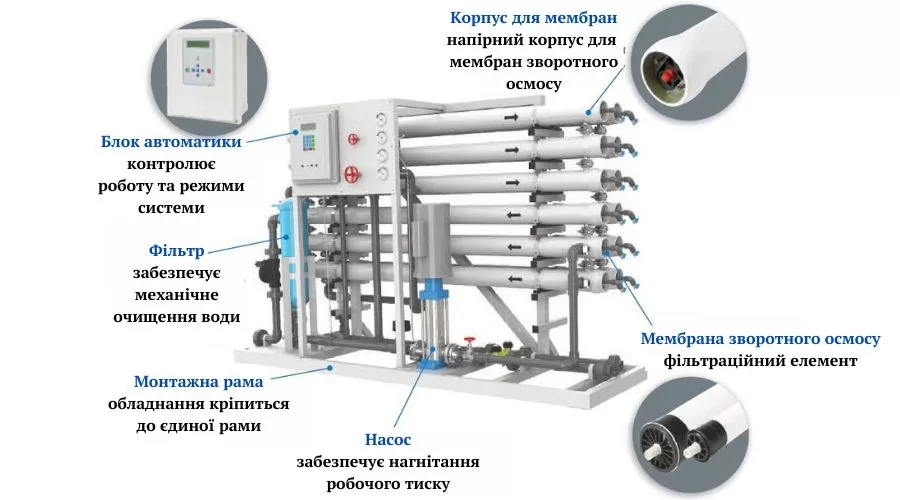
An industrial reverse osmosis system consists of the following components:
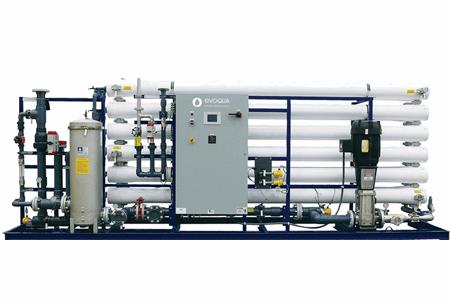
- A pre-treatment filter for incoming water;
- A high-pressure pump;
- One or several reverse osmosis membranes arranged in parallel or in series;
- Control and automation: the reverse osmosis system includes a computerized control unit for automatic regulation of the filtration process, water quality monitoring, and pressure control;
- Measuring and monitoring instruments.
The system is operated by a dedicated controller using specialized software.
During the reverse osmosis process, water passes through a mechanical barrier that effectively retains contaminants while allowing only water molecules and dissolved oxygen to pass through. A significant portion of mechanical impurities is removed at this stage, particularly coarse contaminants that could damage the sensitive reverse osmosis membranes.
Next, the water is forced under pressure through the membrane, where demineralization occurs. Most of the purified water is directed for further use, while a small portion is used for hydraulic membrane flushing (typically within one minute). The flushed water is discharged into the sewage system.
Reverse osmosis systems demonstrate some of the best economic indicators in terms of treated water cost. The cost of 1 liter of purified water produced by an industrial reverse osmosis system is approximately 0.02 UAH.
For specialized industries that require a specific mineral composition of the final product (for example, mineral water production), an additional remineralization unit can be installed.
Operational features of industrial reverse osmosis systems
Monitoring the operating condition of an industrial reverse osmosis system is straightforward and is based on measuring the electrical conductivity of the treated water at the outlet (as light ions are the most difficult to remove) and system productivity. These instruments are typically integrated into industrial systems. An increase in conductivity or a decrease in productivity indicates the need for membrane cleaning or replacement.
System maintenance includes regular replacement of pre-treatment cartridges at least once every three months to prevent membrane damage or failure. To ensure consistent water quality, chemical cleaning of reverse osmosis membranes is recommended at least twice a year using a chemical cleaning station and dedicated reagents.
A mandatory condition for safe operation is daily system operation for at least one hour per day. In the event of prolonged downtime (more than 48 hours), chemical preservation of membrane elements must be performed. It is recommended to shut off the water supply to the system and preserve the membranes using a special solution, which helps maintain membrane performance during idle periods.
Today, reverse osmosis technology is essential for water treatment under modern industrial conditions. It ensures safe water for production processes and helps reduce equipment operating costs. In addition, it enables compliance with stringent water quality requirements for industrial applications.
Why water treatment is essential for industrial enterprises
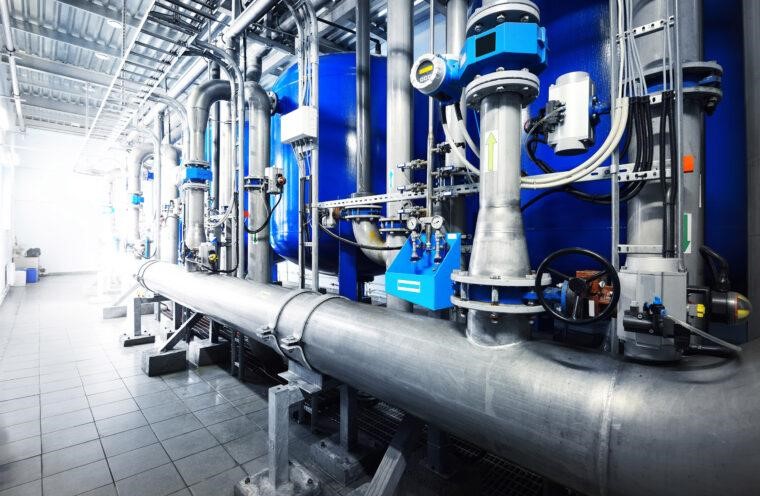
Industrial reverse osmosis systems and other types of water treatment filters offered by ZIKO allow extending the service life of equipment and improving the quality of manufactured products. Financial costs for maintenance, repair, or replacement of equipment that comes into contact with water are significantly reduced. Demand increases for products manufactured using high-quality treated water.
An industrial reverse osmosis system properly designed with regard to technological process requirements removes most substances dissolved in water. During the process of forcing the feed solution through a semi-permeable membrane (in the direction opposite to natural osmosis), the solution becomes less concentrated. Such a filter is capable of removing contaminants sized from 0.001 to 0.0001 microns. As a result, up to 99.8% of impurities are removed.
Water treated by an industrial reverse osmosis system allows to:
• Increase the efficiency of hot-water and steam boilers, prevent corrosion of pipelines and condensate lines
• Improve the quality and safety of mineral and drinking water, alcoholic and non-alcoholic beverages, juices, and enhance their organoleptic properties
• Significantly improve product quality, safety, and compliance with standards across various industries
• Demineralize water at car washes and laundries, eliminating stains and deposits caused by hardness salts
• Treat highly saline water or desalinate seawater
• Remove all possible contaminants, including bacterial ones, for example in restaurants, cafés, and offices, improving water and food quality and eliminating health risks
In all industrial sectors, water treated using reverse osmosis systems completely eliminates the risk of scale or sediment forming on equipment surfaces. This significantly extends equipment lifespan and prevents production downtime caused by such issues.
Why your enterprise needs industrial reverse osmosis systems
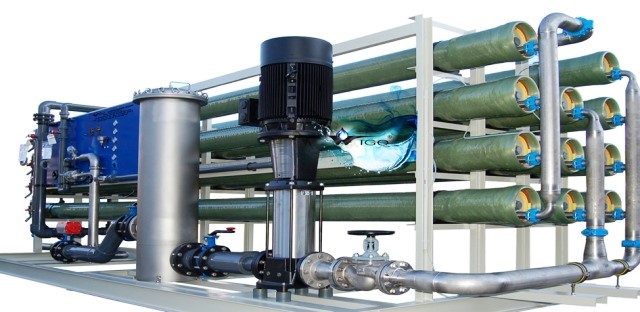
Installation of an industrial reverse osmosis system at an enterprise makes it possible to obtain water of the required quality in the necessary volume, regardless of the quality of the incoming water. This provides the following benefits:
• such water can be safely used for food preparation, drinking, and for both domestic and industrial applications without boiling;
• all microelements are removed, eliminating the risk of equipment failure caused by scale or sediment deposits;
• pipelines and equipment do not clog and are not exposed to corrosive effects;
• scale does not form in boilers and heating devices, which would otherwise reduce their efficiency and service life;
• in the thermal power sector, water treated by an industrial reverse osmosis system reduces electricity consumption and makes it possible to save significant costs on wastewater treatment;
• the technology does not require the use of chemical reagents, therefore there is no need to treat wastewater before discharge into the sewer system.
An important factor supporting the feasibility of implementing this technology is the versatility of industrial reverse osmosis systems, which are capable of treating water at temperatures of up to 45 °C. The systems can also treat already used water and reuse it in technological processes, which allows saving this valuable resource.
Why reverse osmosis is an optimal and cost-effective solution for industrial water treatment
If it is necessary to supply all technological processes at your enterprise with high-quality treated water, the most optimal solution from both a design and economic standpoint is industrial reverse osmosis. The reasons are as follows:
- It is a universal solution. All types of contaminants are removed simultaneously — organic impurities, dissolved salts, bacteria, and microorganisms.
- Oxidizability is significantly reduced, while turbidity and color are completely eliminated. Water is treated to an almost ideal state and, in terms of chemical and organoleptic properties, becomes comparable to glacial meltwater.
- The compact design of such systems allows efficient use of available space.
- High reliability of the technology, combined with good maintainability and low operating costs.
- Environmental safety — industrial reverse osmosis systems do not require alkalis, acids, or salts that are harmful to the environment or human health for water regeneration.
- Lower energy consumption for desalination compared to alternative technologies.
The advantages listed above make it possible to significantly reduce costs associated with equipment repair, replacement, and maintenance, as well as electricity expenses. The reliability of the method eliminates the risk of production downtime caused by system failures or poor water quality. As a result, production costs decrease, product competitiveness increases, and demand grows due to improved quality and availability.
Service life of industrial reverse osmosis systems
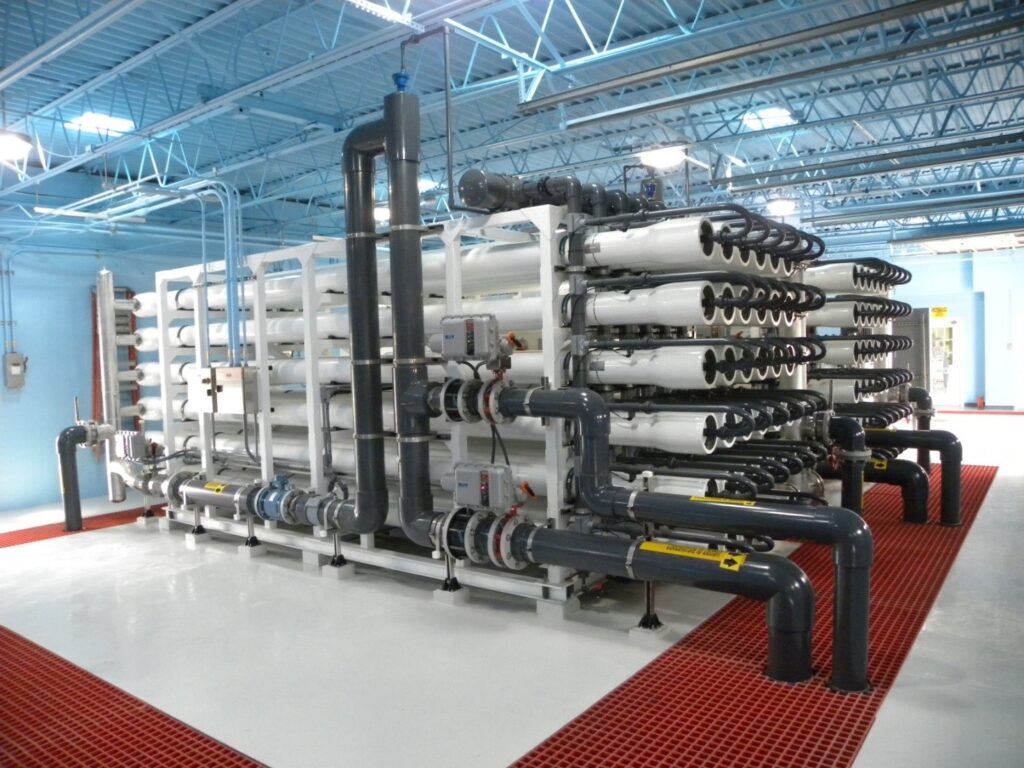
Different manufacturers specify different service lives for industrial reverse osmosis systems. On average, membrane replacement is required after 1.5 to 4 years. This period depends on several factors:
- Chlorine presence in water.
The membrane is made of a polyamide film that is sensitive to prolonged exposure to chlorine. - Feed water contamination.
A high concentration of mechanical impurities in untreated water (clay, sand, chalk, silt, rust) significantly reduces membrane service life. - Water hardness.
The higher the hardness, the faster an insoluble scale layer formed by hardness salts builds up on the membrane surface, blocking water passage through the membrane pores.
To avoid the issues listed above and significantly extend the service life of an industrial reverse osmosis system, proper pre-treatment of feed water is required.
Another factor affecting the service life and performance of a reverse osmosis system is the proper operation of its automation components. For example, failure of the check valve or four-way valve may result in excessive water volume being supplied to the membrane under pressure. This leads to reduced efficiency and shortened membrane lifespan.
It is also important to monitor the cleanliness of the drain flow restrictor. If it becomes clogged, effective membrane flushing is impaired, which further reduces membrane service life.
Water preparation for installing an industrial reverse osmosis system
To reduce chlorine concentration in the feed water and extend the operating life of an industrial reverse osmosis system, it is mandatory to install a carbon pre-filter cartridge at the system inlet.
To remove mechanical impurities from the feed water and maintain the required efficiency of the industrial reverse osmosis unit, it is recommended to install an automatic multimedia filtration system upstream.
To reduce water hardness before feeding it into the reverse osmosis system, either a water softening filter or an antiscalant dosing station should be installed at the inlet.
Do you have additional questions?
Please contact us — we will be glad to provide you with professional consultation.