
Water from natural sources rarely meets sanitary standards in its original composition. Well water often contains significant amounts of dissolved iron and hydrogen sulfide. This can be immediately identified by a characteristic unpleasant metallic odor or the smell of rotten eggs. Drinking such water is not only unpleasant but also potentially hazardous to health.
Hydrogen sulfide is a colorless gas with a characteristic odor resembling decay or rotten eggs. It is formed as a result of anaerobic bacterial activity in environments with limited oxygen supply, where sulfur compounds are converted into hydrogen sulfide gas. Due to this distinctive smell, its presence in well water can often be detected even without prior laboratory analysis.
The presence of hydrogen sulfide in groundwater may be caused by the following factors:
- silting of the source due to stagnant conditions;
- use of fertilizers containing sulfur compounds near the water source;
- close proximity to sulfide-bearing geological formations.
Hydrogen sulfide at concentrations exceeding permissible limits is hazardous to human health. It can cause poisoning, headaches, inflammation of the throat mucosa, general weakness, and at high concentrations — even pulmonary edema. This toxic gas replaces part of hemoglobin, causing oxygen deficiency in the body.
Hydrogen sulfide also exhibits high corrosive activity in domestic conditions, leading to metal degradation, damage to household appliances, and destruction of water supply pipelines.
Therefore, before supplying such water to a residential building, it is usually necessary to install appropriate filtration systems. The use of hydrogen sulfide–contaminated water in industrial production is effectively prohibited by regulations and can severely affect the quality of finished products.
There are various types of filters for removing hydrogen sulfide and iron, based on different media with distinct characteristics. One such filtration medium is Centaur.
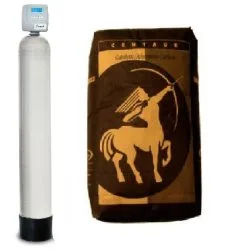
Centaur media by Calgon Carbon is a high-performance bituminous granular activated carbon designed for removing chlorine, iron, and hydrogen sulfide from water, as well as for effective correction of water odor and taste. The product is unique in that it concentrates reactants through adsorption and then promotes their reaction on pore surfaces. CENTAUR is produced from bituminous coal using a patented process. Although it is not impregnated with metals or alkalis, it demonstrates catalytic functionality similar to such materials. In most cases, the media can be regenerated and does not pose disposal issues associated with impregnated carbons.
Operating Principle of Centaur Media for Removing Hydrogen Sulfide, Iron, and Chlorine
The system consists of a column made of high-strength, corrosion-resistant plastic, equipped with an automatic control valve manufactured by Clack Corp. (USA). The unit is connected to the cold water pipeline, sewer system, and power supply for the control valve.
During operation, water passes through the column filled with filtration media (bituminous activated carbon Centaur), which accumulates contaminants. Due to the high adsorption capacity of the media, treatment efficiency and filtered water quality are significantly improved. The treated water is supplied to the consumer or may undergo additional polishing treatment.
It is recommended to install a preliminary mechanical cartridge or mesh filter upstream of the system to remove mechanical impurities such as sand, rust, scale, and silt. The system is intended for cold water treatment only.
Media Regeneration
Restoration of the filtration media’s working properties is performed automatically by backwashing with a reverse water flow, without the use of additional reagents. As a result, accumulated contaminants are removed from the media granules and discharged into the sewer system. After regeneration, the filter is ready for continued removal of hydrogen sulfide and other contaminants. Regeneration is carried out using untreated inlet water.
Centaur activated carbon granules have high mechanical strength, allowing repeated regeneration cycles without loss of initial performance characteristics.
The media has a high adsorption capacity — not only the outer surface but the entire granule is activated. Stable and consistently high quality is ensured by the manufacturing technology and granule uniformity. Centaur media complies with EN 12915, holds the KIWA ATA certificate, and is approved by the UK Drinking Water Inspectorate.
Control Automation
The control valve developed by Clack Corporation (USA) ensures fully autonomous operation of the filter and a constant supply of treated water.
Advantages of the Centaur-Based System for Removing Hydrogen Sulfide, Iron, and Chlorine
- high efficiency of iron and hydrogen sulfide removal;
- high media capacity for iron and hydrogen sulfide;
- high filtration performance;
- low pressure loss compared to other filtration media;
- regeneration without the use of chemical reagents.
Service
Thanks to the multifunctional control valve, the system operates automatically. Backwashing is performed according to a preset schedule, and a self-diagnostics function is available, displaying error codes on an electronic screen.
CENTAUR HSL can also be used as a catalyst for the following chemical reactions:
- oxidation–reduction reactions;
- halogenation reactions;
- dehydrohalogenation reactions;
- polymerization reactions;
- isomerization reactions;
- oxydehydration reactions;
- cracking reactions.
The system is recommended both for small apartments or houses with 2–3 bathrooms and for industrial applications requiring high treatment capacity.
More detailed information can be obtained by contacting our specialists via the Contacts section.