Water treatment for water utilities and communities

Industrial water treatment
Water treatment for water utilities and communities
Water for the community — within quality standards. We treat groundwater and surface water to meet DSanPiN 2.2.4-171-10.
- In-house laboratorywater analysis and testing
- 1,760+ completed projectsZIKO experience since 1993
- Up to 5-year warrantyon solutions and equipment, under the contract terms
- Service across Ukrainetechnical support and field service crews
Problems
Water supply problems ZIKO solves
The water fails to meet standards, the networks are worn out and the stations lack capacity. Costs go up, and it gets harder to deliver good water to consumers.
Who needs water treatment

City water utilities
We treat groundwater and surface water, upgrade existing stations and bring water quality and supply volume up to standard.

Territorial and rural communities
Water treatment for centralized water supply in villages and towns, reconstruction and upgrades of existing stations.

Individual wells and local water mains
We eliminate exceedances in quality parameters and bring the system up to the required capacity. If the problem is in one well, we install a station in its pavilion without rebuilding the whole network.

Municipal and social facilities
Water treatment for hospitals, schools, kindergartens and other municipal facilities, matched to their water quality and volume requirements, including backup water supply when the network has no pressure.
What poor water quality leads to
Non-compliance with regulations
Lab monitoring records exceedances in iron, manganese, ammonium or microbiology. Then comes an order with a deadline to fix it, while the technical problem remains.
Consumer complaints
Cloudy or discolored water with an odor or taste is the most common reason for complaints. People judge the utility by what they see in the glass.
Extra operating costs
Deposits in pipes and equipment reduce network capacity, increase pump power consumption and raise maintenance and repair costs.
Microbiological risks
Pathogens threaten consumers’ health. Cloudy water is harder to disinfect: suspended particles shield microorganisms from UV light, and organic matter “eats up” the chlorine dose. That is why pretreatment comes first, then disinfection.
Water requirements
Which water quality parameters most often need correction
Groundwater, surface water and mains water differ significantly. That is why we choose the treatment method by the full set of physicochemical and microbiological parameters, not by one. An extended analysis checks the full list of 83 regulated parameters.
Parameter, standard, consequences of exceedance
| Parameter | Standard | Consequences of exceedance |
|---|---|---|
| Iron | regulated | Discolored water, sediment, deposits in networks |
| Manganese | undesirable above 0.05 mg/L | Dark deposits, worse taste and color |
| Turbidity | regulated | Suspended particles, less effective disinfection |
| Ammonium | ≤ 0.5 mg/L | Requires further water assessment and affects the choice of treatment technology |
| Microbiological parameters | regulated | Risks to the sanitary safety of water |
| Hardness and mineralization | regulated | Deposits, restrictions on water use |
| Nitrates | ≤ 50 mg/L | Health risk if exceeded |
| Nitrites | ≤ 0.5 mg/L | Health risk if exceeded |
| pH | 6.5–8.5 | Affects water corrosivity |
Drinking water quality requirements are set by the applicable regulations, in particular DSanPiN 2.2.4-171-10, taking into account applicable amendments and special requirements.
Solution
Integrated solutions for community water supply
ZIKO designs and builds drinking water treatment systems for municipal utilities, communities and social facilities. We do not install off-the-shelf kits: we match the system to the water analysis, required capacity, regulations and operating conditions.
Main areas of work
Drinking water treatment
We treat groundwater and surface water to quality standards and the required supply volume.
Station reconstruction and upgrades
We make existing stations more efficient, fix water quality problems and adjust the system to actual water consumption.
Turnkey delivery
From the specification and engineering solution to installation, commissioning and service.
How it is done at a water utility in the Lviv region
- Open sourceriver: organics, iron, microbiology
- 01Mechanical filtration with automatic backwashcoarse impurities
- 02Iron removal with an alternatoriron, manganese, hydrogen sulfide — no downtime for regeneration
- 03Hypochlorite dosingproportional to flow, via a pulse flow meter
- Reservoir and pumping stationssupply to the city network and a reserve in case of a pressure drop
Core treatment train
- Combined treatment (MIX)
- Mechanical water filtration
- Water softening
- Ultrafiltration (UF)
- Iron and manganese removal
- Reverse osmosis (RO)
Added for this industry
- Odor removal and sorption treatment
- Water disinfection
- Nanofiltration (NF)
- Chemical dosing
Not just equipment, but a system designed for the required water quality and quantity. We weigh capital and operating costs, reliability, ease of maintenance and the growth of the community’s infrastructure.
The station runs around the clock with no night pause and has to handle uneven demand. That is why automatic backwash and an alternator (the columns take turns) are a requirement here, not an option.
Wastewater treatment plants for communities are a separate ZIKO line of work: wastewater treatment plants for territorial and rural communities.
Completed projects
Solutions already running at water supply facilities
We commission sites and support them after start-up: from lab tests to service.

Iron removal — 420 m³/h
Water for the city’s domestic and drinking needs.
After start-up, the ZIKO service crew returns to the station for scheduled work.
Project details →
Iron removal and disinfection — 50 m³/h
Three-stage treatment:
- Self-cleaning filters remove suspended solids, sand and rust.
- Sodium hypochlorite disinfects the water and pre-oxidizes dissolved iron and manganese. They turn into salts that readily hydrolyze and precipitate.
- Catalytic removal of iron and manganese.
-

Water utility in the Lviv region
- Iron removal with an alternator — the columns take turns, so supply is not interrupted for backwash
- Catalytic media based on manganese ore: iron, manganese, hydrogen sulfide
- Automatic backwash, proportional hypochlorite dosing, a clean water reservoir
- The controller runs two to six filters and shows the time to the next regeneration
Planning the community budget for next year?A preliminary estimate helps even before the tender: with it, you can put the amount in the budget. Send us the analysis report — a ZIKO engineer will prepare an estimate.
Get an estimateCost and procurement
Water treatment system cost and procurement via Prozorro
The cost depends on the raw water quality, required capacity, treated water requirements and the site’s specifics. We calculate not only capital costs but also operation and maintenance.
If procurement goes through Prozorro
Preparing the technical specification
We help draft the specification based on a lab analysis of the raw water, the condition of the infrastructure and the site’s actual needs.
- We set: treated water quality, nominal and peak capacity (m³/h, m³/day), operating modes, automation and redundancy.
- We account for: power consumption, chemicals, process wastewater volume and upgrade potential.
We do not tie the specification to an equipment manufacturer. The priority is quality and capacity guaranteed by contract, reliability and the lowest cost of ownership over the entire service life.
Warranty and service
Up to 5 years of warranty on solutions and equipment. Terms depend on the equipment and the site and are set in the contract.
Implementation stages and service
From site survey to stable system operation
We run the project from water testing to service after start-up.
Stage 01 of 04
We survey the site and the water
We choose the treatment method by the full set of parameters, not by one.
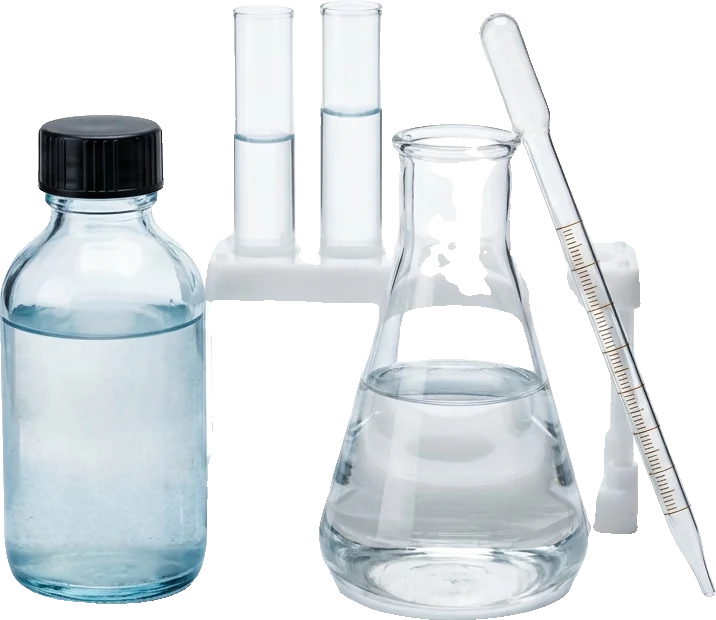
- Survey and water analysisWe study the source, the network, actual water consumption and lab analyses. If needed, we run process tests.
ZIKO has its own laboratory. If needed, we test the raw water on filter media and see the result before the equipment arrives on site.
Stage 02 of 04
We set the requirements in the specification
We draft the specification based on a lab analysis of the raw water, the condition of the infrastructure and the site’s actual needs.
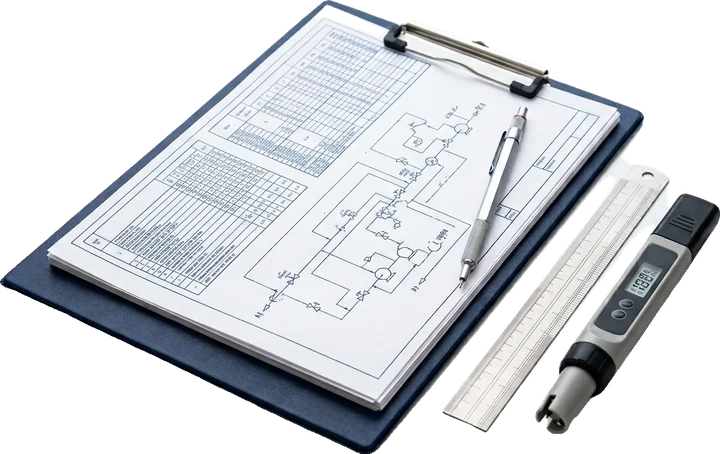
- Technical specificationWe set treated water quality, capacity (m³/h, m³/day), operating modes, automation and reliability.
Stage 03 of 04
We design the solution
Built for your site, not as an off-the-shelf kit.
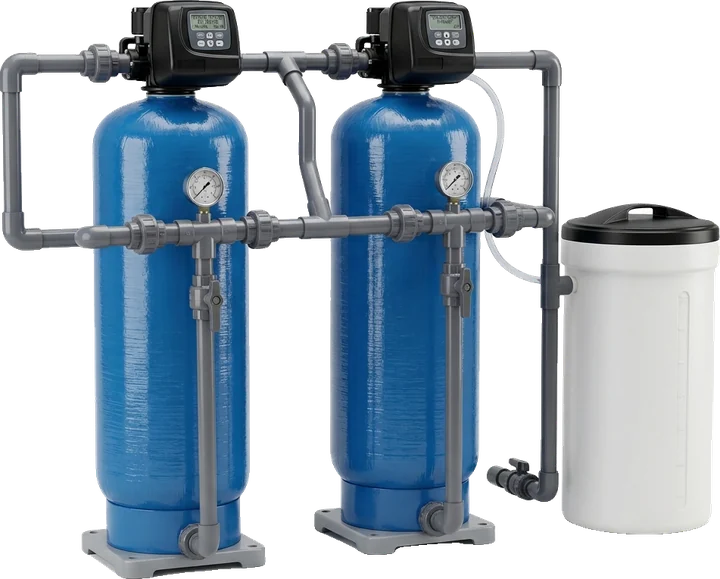
- Engineering solution and designWe develop a solution for the site, weighing capital and operating costs.
Stage 04 of 04
We supply, commission and maintain
From equipment supply to support throughout operation.
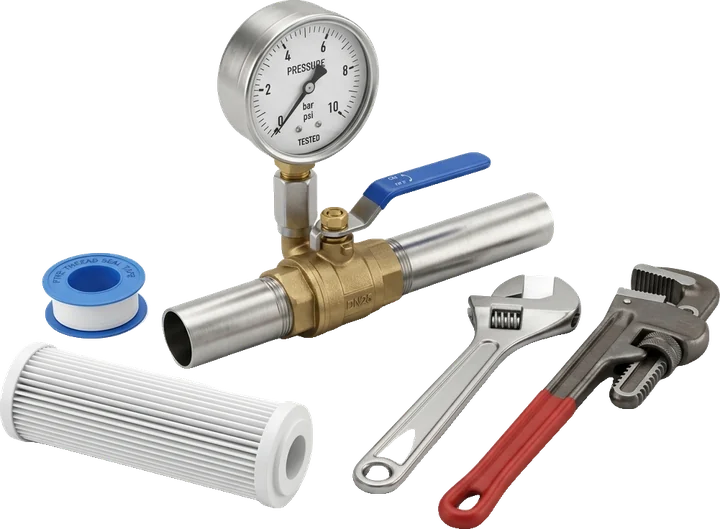
- Equipment and supplyWe source and deliver the equipment per the approved specification and design.
- InstallationWe install the system and integrate it into the existing water supply network.
- CommissioningWe set up the system, check capacity and treated water quality, and train your staff.
- ServiceScheduled maintenance, diagnostics and technical support throughout operation.
Technical support throughout operation
We build the operating schedule around the technology, raw water, operating mode and load. Guideline intervals from the schedule:
- Ion exchange resin
- 3–7 years
- Pretreatment cartridges
- at least every 3 months
- Dosing chemicals
- based on actual consumption
Your staff can maintain the system following our schedule, or ZIKO service engineers can do it. The station controller shows the system status and the time to the next filter regeneration, so the operator does not have to count cycles by hand. After start-up, we help keep the design parameters and respond to changes in water supply.
Our priority is consistent treated water quality, the required capacity and predictable operating costs.
FAQ
Answers for water utilities and communities
A difficult situation with water quality, capacity or station performance? ZIKO engineers will help you sort it out — ask in the form below.
Why does water turn yellow or brown after the network sits idle?
The cause may be iron and manganese deposits, corrosion or sediment in the pipelines. If the color appears in the morning after the night idle period, iron is most likely settling in the network — the fix is iron removal at the inlet, not flushing. To find the source, the water is tested at the network inlet and at control points.
Is hypochlorite dosing enough for the water to meet standards?
Not always. Hypochlorite disinfects water and oxidizes some impurities, but it does not replace full treatment: iron, manganese and turbidity remain, and in cloudy water the dose is spent on organic matter. A water analysis shows which other stages are needed.
What if only one well exceeds the limits?
The solution depends on the water composition, well yield and the water supply layout. It is often cheaper to install a station in that well’s pavilion than to treat the whole network. We choose the option after a technical survey.
Do you need to stop water supply while filters are backwashed?
Not necessarily. If the system has an alternator or standby filters and a water reserve, backwash runs without interrupting supply. One controller can run two to six filters.
Can an existing station be upgraded without replacing all the equipment?
Yes, if the condition and specifications of the existing equipment allow it to keep running. We survey the station, assess what can be kept and propose a solution with a feasibility study.
What does the cost of a water treatment system for a community depend on?
On the raw water quality, required capacity, treatment requirements, the condition of the infrastructure and where the equipment will be placed. We calculate capital costs, power consumption, chemicals and maintenance. A preliminary estimate is useful even before the community budget is drawn up.
Get a consultation with a ZIKO engineer
Planning a new system or an upgrade, or having problems with water quality and volume? Describe your task and attach a water analysis if you have one. A ZIKO engineer will review the data and propose a solution with capital and operating cost estimates.
Consultation and preliminary estimate are free.
Phone: +38 095 93 21 273