
Water disinfection for businesses

Water treatment technologies
Water disinfection for businesses
ZIKO engineered solutions for the microbiological safety of water: UV, sodium hypochlorite, chlorine dioxide, ozonation. We select the method based on water composition, capacity (m³/h, m³/day) and operating mode.
- In-house laboratorywater analysis and testing
- 1,760+ completed projectsZIKO experience since 1993
- Up to 5-year warrantyon solutions and equipment, under the contract terms
- Service across Ukrainetechnical support and field service crews
Choosing a method
How to choose a water disinfection method
The choice depends on water quality, capacity, the water use pattern and whether you need a residual disinfecting effect.
High-intensity UV radiation inactivates microorganisms without chemical reagents. Suitable for drinking water, process water and treated wastewater.
It leaves no residual effect, so it works best where water goes straight into the process. More about UV disinfection
Sodium hypochlorite and chlorine dioxide disinfect water and maintain a residual concentration of disinfectant in tanks and pipelines.
The reagent and dosing mode depend on water quality, contact time and water consumption.
What ZIKO engineers take into account
- Water quality — physicochemical and microbiological parameters.
- Capacity — m³/h, m³/day, peak loads.
- Water supply layout — tanks, pipelines, points of use.
- Automation — disinfection monitoring and integration with the control system.
Methods
Disinfection technologies compared
All methods disinfect. They differ in residual effect, the reagents they add to the water and what you need to monitor in operation.
| Criterion | UV disinfection | Sodium hypochlorite | Chlorine dioxide |
|---|---|---|---|
| Principle | Microorganisms inactivated by UV radiation | Chemical disinfection | Chemical disinfection |
| Residual effect | None | Yes, under proper conditions | Yes, under proper conditions |
| Reagent addition | Not required | Required | Required |
| Key water parameters | UV transmittance, turbidity, fouling | pH, organic matter, chlorine demand | Water composition, reducing agents |
| Process monitoring | UV intensity, water flow, lamp condition | Dosing, residual chlorine, water flow | Dosing, residual chlorine dioxide |
| Specifics | No protection against recontamination | Chlorination by-products may form | Chlorites and chlorates must be monitored |
What exactly the system monitors depends on the equipment package. Methods can be combined: sites with a tank and a network often do this.
Like UV, ozonation leaves no residual effect, but it removes color, taste and odor — more about ozonation.
We define capacity (m³/h, m³/day), pretreatment requirements, disinfection conditions, operating modes and automatic monitoring parameters.
Each method in detail
- UV disinfection
- Sodium hypochlorite dosing
- Chlorine dioxide
- Ozonation
Industries where disinfection is part of the system
- Agriculture: poultry and livestock
- Breweries
- Energy, CHP plants, industrial boiler houses
- Pharmaceutical and medical production
- Hotels, spas, restaurants, shopping malls
- Food processing
- Chemicals, cosmetics, household chemicals
- Other industrial production
- Crop farming, greenhouses, irrigation
- Water and soft drink bottling
- Distilleries and spirits production
- Textile and paper production
- Water utilities and municipalities
- Educational institutions
- Housing, condominiums, residential complexes
Applications
Where industrial water disinfection is used
Disinfection sits at the end of the water treatment train, in recirculating water loops and at the outlet of treatment plants.
Drinking and process water
Food production, industrial processes, hotels, water supply systems.

Recirculating water
Recirculation and reuse systems, including in food production.

Treated wastewater
UV disinfection after the main treatment stages: before discharge or reuse, to the applicable requirements.
Pretreatment
Effective disinfection starts with assessing water quality
Whether you need pretreatment depends on the water composition, the method and the required disinfection efficiency. We check the water composition in our own lab and test the pretreatment there too.

Turbidity and suspended solids
Suspended matter shields microorganisms from UV. We select mechanical filtration, ultrafiltration or clarification based on the analysis.

Iron and manganese
They deposit on UV equipment surfaces and reduce its efficiency, and oxidized iron turns into suspended solids. On groundwater, iron removal always comes first.

Organic matter
Absorbs UV radiation and consumes chemical disinfectant. For chlorine-based methods it also means organochlorine compounds in the finished water.

Tanks and network after the unit
Water can get contaminated again in a tank or a stagnant section of pipe. That is why we check the layout after the unit along with the analysis.
Completed projects
Completed ZIKO disinfection systems
We use hypochlorite where the network needs a residual effect. UV goes where water flows straight into the process.

Water utility: automated sodium hypochlorite dosing
Scheme: self-cleaning mechanical filter → alternating duplex iron removal → hypochlorite dosing station → pumping stations and clean water tank.
A city network must have a residual effect, so disinfection here is chemical, with a dose that follows the flow.
-

Poultry complex: UV ahead of the drinking lines
- UV disinfection — the final stage before the drinking lines
- Six farms; well water at about 1 °C, no heating
-
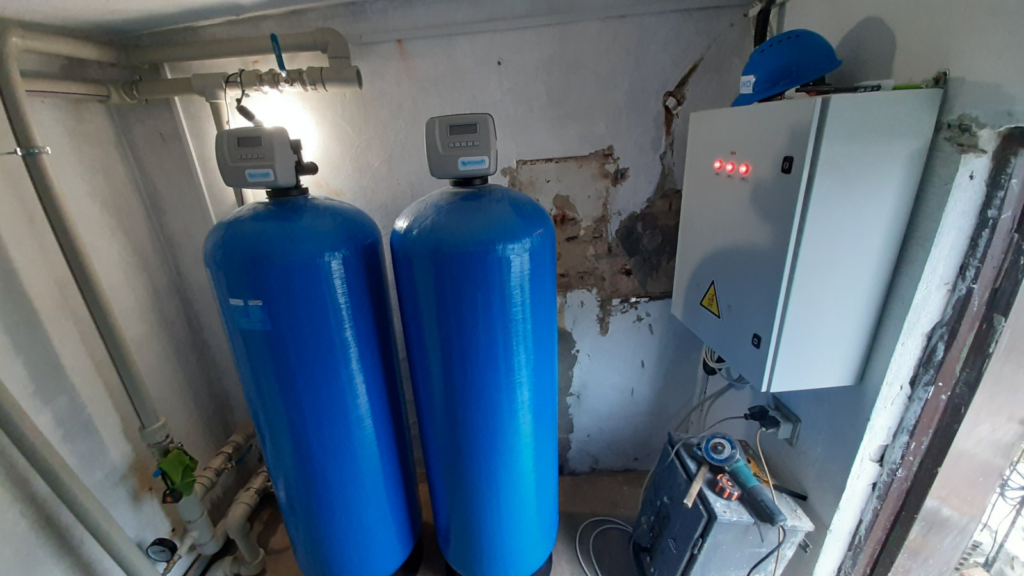
Educational institution: UV after RO
- UV — the final stage after combined treatment, sorption and RO
- Disinfection even after RO — a guarantee at the point of use
Two more sites with UV disinfection: a meat and dairy plant and a restaurant with its own brewery.
Not sure if you need a residual effect?Describe your site and what comes next in the system — a ZIKO engineer will tell you which method fits and what should go ahead of it.
Discuss your project with an engineerCost
Cost of a water disinfection system
We calculate the cost individually: by water analysis, capacity, treated water requirements and operating conditions.
What drives the cost
- Disinfection method and whether a residual effect is needed.
- Capacity and operating mode — m³/h, m³/day, peak loads.
- Raw water quality — what pretreatment is needed ahead of disinfection.
- Equipment package and automation — equipment redundancy, monitoring of operating parameters, integration with the control system.
Capital costs: equipment, automation, installation and commissioning.
Operating costs: electricity, UV lamp replacement, reagent consumption, maintenance.
For each site we calculate several options and compare them on cost and reliability.
FAQ
Most frequently asked questions
Didn’t find your question? Ask an engineer using the form below.

Which disinfection method is best for a business?
There is no one-size-fits-all solution. If water goes straight into the process, use UV, because it adds nothing to the water. If there is a tank and a network, you need a residual effect, which means a chlorine-based reagent.
Can UV replace chlorine at a water utility?
At the inlet, yes; in the network, no. UV leaves nothing in the water that keeps working downstream, and that is exactly what a municipal network needs. So these sites usually combine methods.
Can UV be used to disinfect treated wastewater?
Yes. Industrial UV systems disinfect wastewater after treatment. We select the equipment for the effluent composition, capacity and required efficiency.
Why is the analysis still bad after disinfection?
The most common cause is turbidity or iron at the inlet: they shield microorganisms and consume reagent. The second is contamination after the unit, in a tank or a stagnant section of pipe.
Is disinfection needed if RO or ultrafiltration is already installed?
Often, yes. Membranes retain bacteria, but they have no effect in the network downstream. Where you need a guarantee at the point of use, disinfection goes in as the final stage. That is what we did at the educational institution above: UV comes after RO.
What is needed to design a disinfection system?
A water analysis, capacity and operating mode. Most importantly, the site layout after the unit: whether there is a tank, how branched the network is, where the water goes. This determines whether a residual effect is needed.
We will design a disinfection system for your plant
Describe your task. A ZIKO engineer will review the input data, select the method and capacity, and calculate a preliminary cost. No water analysis or specification? We will help you gather the input data. Consultation and preliminary estimate are free.
Phone: +38 095 93 21 273
Where to go next
Related technologies
Water sources
- Rainwater and meltwater
- Surface water: rivers, lakes, ponds, canals, reservoirs
- ZIKO 360 — reuse of treated wastewater