
Industrial Reverse Osmosis Systems

Water treatment technologies
Industrial Reverse Osmosis Systems
Desalination of water to your production requirements. We design and commission RO systems for your water and your required capacity.
- Completed systems up to 100 m³/h
- Filtration limit below 0.0001 µm
- Membrane life 1.5–4 years
- In-house laboratorywater analysis and testing
- 1,760+ completed projectsZIKO experience since 1993
- Up to 5-year warrantyon solutions and equipment, under the contract terms
- Service across Ukrainetechnical support and field service crews
Applications
What reverse osmosis is used for
RO reduces salinity, which softening and ultrafiltration cannot do. If the only issue is scale or suspended solids, a simpler technology will cost less to run.
| What needs removing | Softening | Ultrafiltration | Nanofiltration | Reverse osmosis |
|---|---|---|---|---|
| Scalehardness salts: calcium and magnesium | removes | no | removes | removes |
| Salinitytotal dissolved solids | no: salts are exchanged | no | partly | removes |
| Nitrates, chlorides, sodiummonovalent ions | no | no | partly | removes |
| Suspended solids, bacteria, virusesturbidity and microbiology | no | removes | removes | removes, but needs pretreatment |
| What goes to draincontinuous flow or batch discharge | spent brine from regeneration | backwash water | concentrate | concentrate, 15–30% of the feed water |
The boundaries between technologies are not universal: the final choice depends on the water analysis and the treated water requirements.
RO needs no salt: you don’t buy it, and there is less saline wastewater. See the economics in the Cost section.
Where RO is used
- Agriculture: poultry and livestock
- Car washes and AdBlue production
- Breweries
- Energy, CHP plants, industrial boiler houses
- Pharmaceutical and medical production
- Hotels, spas, restaurants, shopping malls
- Food processing
- Chemicals, cosmetics, household chemicals
- Other industrial production
- Crop farming, greenhouses, irrigation
- Water and soft drink bottling
- Distilleries and spirits production
- Textile and paper production
- Water utilities and municipalities
- Educational institutions
- Housing, condominiums, residential complexes
We don’t sell standalone equipment: an engineer reviews your water analysis, decides whether you need RO and calculates the costs.
How it works
How RO works and what makes up the water balance
Water passes through a semi-permeable membrane under pressure. Salts, organics and microorganisms stay on the feed side, so there are two outlet streams.
Unit water balance
pores below 0.0001 µm
≈ 25% is concentrate: the same salts, just at a higher concentration
Water balance calculator
How much water to feed to get what you need
Enter the treated water you need and the operating hours. The calculation assumes a typical recovery of about 75% permeate.
120 m³ of permeate in 12 h of operation — feed about 160 m³, discharge about 40 m³ of concentrate.
A starting point for the first conversation, not a design. The range assumes 70–85% recovery and excludes water for pretreatment and flushing. The engineer calculates the actual recovery from your water analysis.
What drives the water balance
Feed water and product water
Mineralization, hardness, salt composition, temperature, and the permeate quality you need.
Required capacity
How much treated water you need and whether the source can supply enough raw water.
Consumption pattern
Operating hours per day and peak loads.
Concentrate disposal
How much there will be and where it goes.
Water requirements
What goes upstream of RO
RO is almost never the first stage: mechanical filtration, iron removal and sorption come before it. We select the pretreatment for your source and water analysis.
Suspended solids and colloids
Clog the membrane surface.
Iron, manganese, organics
Deposit on the membrane and reduce capacity.
Chlorine and other oxidants
Chemically damage the membrane.
Scaling risk
We calculate whether salts will precipitate in the concentrate and whether an antiscalant is needed.
RO feed water requirements — 16 parametersZIKO recommended guideline values for industrial systems
| Parameter | Unit | Without antiscalant | With antiscalant |
|---|---|---|---|
| Turbidity | NTU | ≤ 0.3 | ≤ 0.3 |
| SDI₁₅ | — | ≤ 5; recommended < 3 | ≤ 5; recommended < 3 |
| Total iron | mg/L | ≤ 0.05 | ≤ 0.05 |
| Manganese | mg/L | ≤ 0.05 | ≤ 0.05 |
| Aluminum | mg/L | ≤ 0.05 | ≤ 0.05 |
| Free chlorine | mg/L | ≤ 0.1; recommended 0 | ≤ 0.1; recommended 0 |
| Humic substances | mg/L | ≤ 10 | ≤ 10 |
| TOC, total organic carbon | mg/L | recommended ≤ 3 | recommended ≤ 3 |
| COD | mg O₂/L | recommended ≤ 10 | recommended ≤ 10 |
| Petroleum products, oils, fats | mg/L | virtually absent | virtually absent |
| pH | — | per calculation and membrane datasheet | per calculation and membrane datasheet |
| Total hardness (Ca²⁺ + Mg²⁺) | mg-eq/L | ≤ 3 | ≤ 30 |
| Silicates | mg/L | ≤ 20 | ≤ 20 |
| Total dissolved solids (TDS) | mg/L | depends on the RO type | depends on the RO type |
| Langelier Saturation Index (LSI) | — | preferably ≤ 0 in the concentrate | may be > 0 per calculation |
| Inlet pressure to the equipment | bar | at least 3 | at least 3 |
There is no universal limit for the Langelier index of the feed water. Carbonate scaling risk is assessed by the calculated LSI of the concentrate, taking into account water composition, temperature, pH and permeate recovery. With an antiscalant, the acceptable positive value is set by calculation and the reagent manufacturer’s recommendations.
ZIKO laboratory testing
ZIKO has its own laboratory. We draw up the technical specification from the analysis and, if needed, test treatment technologies on samples of your water.
And tell you whether further testing is needed.

Configurations
What water quality you can get
The scheme is set by the water quality you need, not by the number of stages. ZIKO’s practical threshold is a conductivity of about 0.5 µS/cm: below that, electrodeionization is required.
RO
Single-pass RO
Conductivity above 5 µS/cm; for 1–5, one or two passes depending on the feed water
Reduces hardness, mineralization and other dissolved impurities.
Applications: food industry, boiler houses, process water, industrial and commercial facilities
RO → remineralization or pH adjustment
RO with composition adjustment
Water with a target mineral composition or pH after desalination
After the membranes, we adjust pH and minerals or blend streams.
Applications: beverages, food industry, processes with water composition requirements
RO I → RO II
Double-pass RO
Conductivity 0.5–1 µS/cm; the limit is verified by calculation
First-pass permeate goes through another membrane.
Applications: steam generators, chemicals, cosmetics, pharmaceuticals
RO I → RO II → EDI
RO plus electrodeionization
Conductivity below 0.5 µS/cm; for a stable < 0.2, EDI is mandatory
Two RO passes plus electrodeionization remove dissolved ions almost completely.
Applications: steam turbines and high-pressure boilers, electronics, AdBlue, laboratory water
Completed projects
RO systems already in operation
From a 2 m³/h unit for a steam turbine to 100 m³/h at a food plant.
Energy · 2 m³/h
steam turbine feed
Why this scheme
Deep desalination for a steam turbine
Scheme: 130 µm disc filters → first-pass RO → second-pass RO → electrodeionization.
The turbine requires no more than 0.2 µS/cm: the system meets it with margin.
-

Reverse osmosis — 100 m³/h
- In operation for over a year
-

Reverse osmosis — 40 m³/h
- We developed the engineering solution and the system for the plant
-
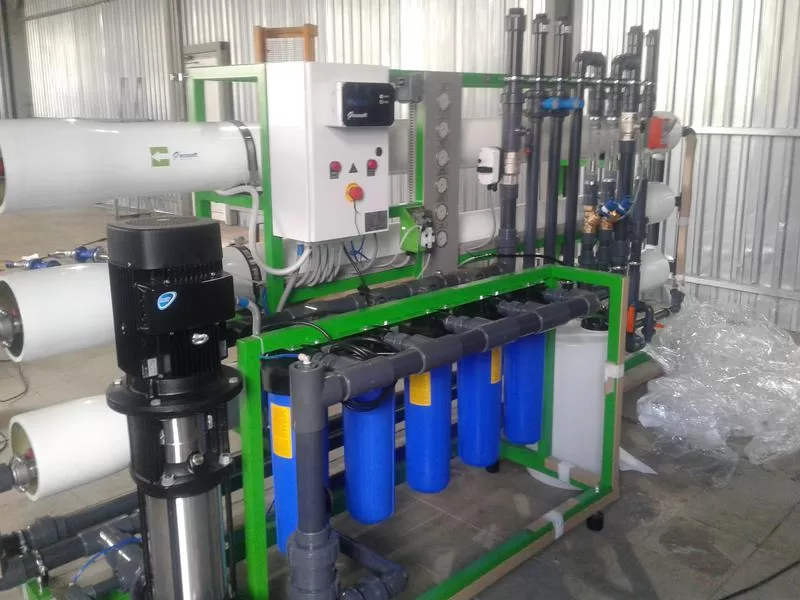
Water for the product and steam generators
- 30 m³/h — water for the product, for the concentrate steam generators and for heating
- Industrial reverse osmosis unit and pumping stations
-
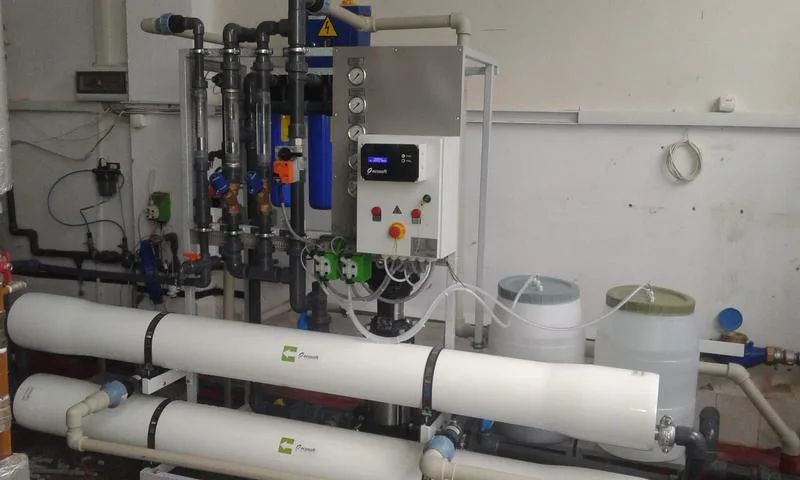
Water to match the feed recipe
- RO and a remineralization station bring the water composition in line with the recipe
RO also runs at an office complex in Lviv and at a meat and dairy plant.
Want to know which configuration you need?Send us your water analysis and required capacity — a ZIKO engineer will select the scheme and calculate the water balance.
Get a consultationCost
Costs more upfront, less to run
We price the system from your water analysis, capacity and treated water requirements.
What drives the figure
- Raw water composition and pretreatment
- Capacity and operating schedule
- Permeate quality: conductivity and number of passes
- Where the concentrate goes
RO or ion exchange softening
Softening constantly consumes salt and produces saline wastewater. RO works without salt but uses electricity, chemicals and membranes, and produces concentrate.
After RO, the wastewater mineralization is about 1,500 mg/L versus 25,000 mg/L for ion exchange regeneration water. Such regeneration water cannot always be discharged to the sewer: that depends on its actual composition and the sewer operator’s terms.
Two schemes compared for an 800 m³/day site
- The difference in investment pays back in 2 years
- Cost of treated water — about UAH 0.02 per liter
Operation and service
From design to stable operation
From water analysis and calculations to commissioning and service.
Stage 01 of 04
Survey and analysis
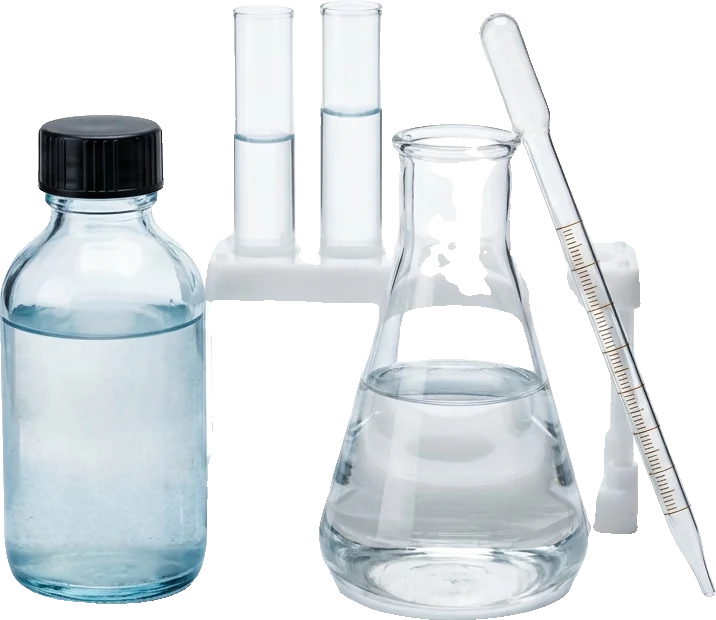
- Water analysisLaboratory testing and water requirements
Stage 02 of 04
Calculation and solution
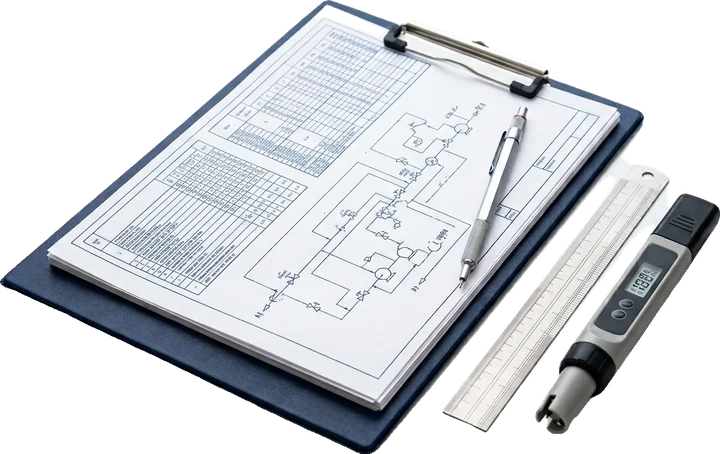
- Engineering calculationProcess solution and water balance
Stage 03 of 04
Design
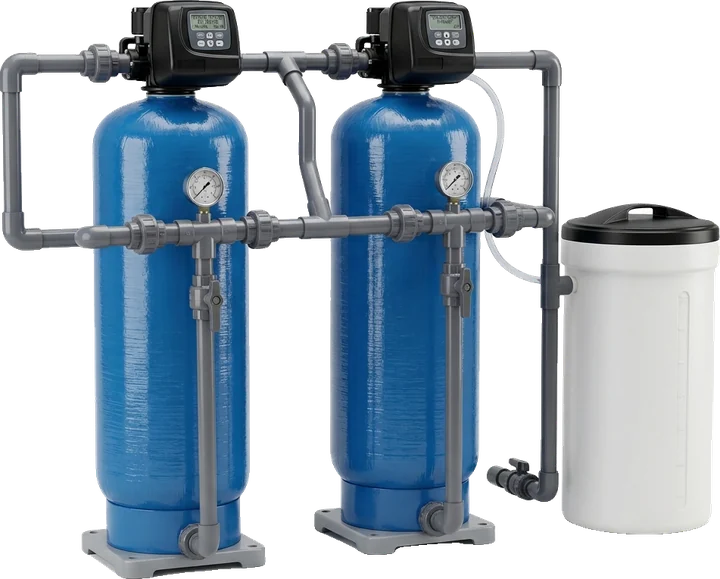
- Design packageTechnical documentation and approvals
Stage 04 of 04
Installation, start-up and service
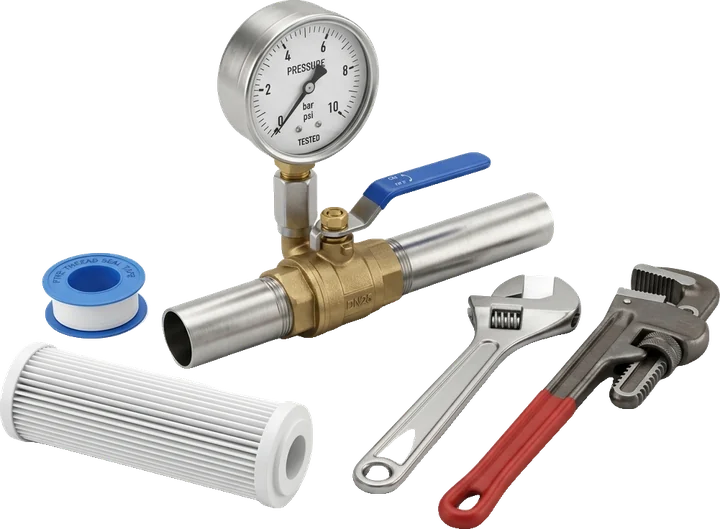
- Equipment supply
- Installation
- CommissioningSetting operating modes, staff training
- Service
Service life and cleaning
- Membranes
- 1.5–4 yearswith regular chemical cleaning, 4–5
- Chemical cleaning
- at least 2 times a yearat pH 3
- Pretreatment cartridges
- at least once every 3 months
Operating mode
- Time to reach steady state after start-up
- 4–5 hours
- Minimum run time
- at least 1 hour per day
- Downtime over 48 hours
- preservationwith a special solution
Service support
Warranty and post-warranty service.
- Diagnostics
- Pretreatment checks
- Replacement of consumables
- Consultations
Automation and control
If needed, we equip the RO system with automation and remote monitoring.
Parameter monitoring
Pressure, differential pressure, flow rate, conductivity, pH and water levels.
Control and protection
Start, stop, flushing; alarm states, pumps and dosing.
Remote access
You can see the system status and control the main functions remotely.
Membrane chemical cleaning (CIP)
Scheduled based on flow rate, differential pressure and salt passage.
Roughly 15–30% of the feed water becomes concentrate: the same salts and impurities, plus chemical residues.
- Most often to the sewer, if the volume and composition meet the acceptance conditions
- Equalization with other wastewater
- Further treatment
- Reuse of part of it (ZIKO 360)

FAQ
Industrial RO: frequently asked questions
Didn’t find your question? Ask an engineer using the form below.

Reverse osmosis or ion exchange softening: which pays off better?
Both technologies reduce hardness, and RO also reduces salinity. If scale is the only issue, softening is often enough. RO costs more upfront but needs no salt regeneration, so at large volumes it is cheaper to run. We compare options without being tied to any equipment manufacturer.
How do you size an RO system?
From your treated water demand, operating mode and permeate recovery. For example, at 75% recovery, 10 m³/h of treated water requires about 13.3 m³/h of feed water. There will be about 3.3 m³/h of concentrate.
When do you need one RO pass and when two?
It depends on the outlet conductivity you need. Above 5 µS/cm, one pass is usually enough; for 1–5 µS/cm, one or two. For 0.5–1 µS/cm, you need two passes. Below 0.5 µS/cm, electrodeionization is added after RO to keep the value stable. Example: water for a steam turbine.
How long do membranes last?
From 1.5 to 4 years. With regular chemical cleaning, at least twice a year, their life extends to 4–5 years. Without care, membranes fail within a year or two.
Can an RO system run on a production schedule?
Yes, if you follow the start-up, shutdown and flushing procedures. The unit must run for at least an hour a day, otherwise biofouling develops on the membranes. Downtime over 48 hours requires preservation with a special solution.
Can I feed RO directly with mains or well water?
No, you need pretreatment. At the RO inlet: iron ≤ 0.05 mg/L, turbidity ≤ 0.3 NTU, free chlorine ≤ 0.1 mg/L, pressure ≥ 3 bar. We select the pretreatment from the analysis and, if needed, test the water on filter media.
Need an industrial reverse osmosis system?
Send us your water analysis and required capacity — an engineer will select the scheme and calculate the investment and running costs. No analysis yet? We’ll test your water in the ZIKO laboratory. Consultation and preliminary estimate are free.
Phone: +38 095 93 21 273
Where to go next
Related technologies
- Water softening
- Ultrafiltration (UF)
- Nanofiltration (NF)
- Electrodeionization (EDI) and deep demineralization
Water sources
- Boreholes and groundwater sources
- Mains water supply
- ZIKO 360 — reuse of treated wastewater